
Data card - AI in HR in 8 figures
To quickly see where HR stands with AI, we compile the key figures from the Brightmine research in one glance. Use this card as a reality check on your own HR practice.
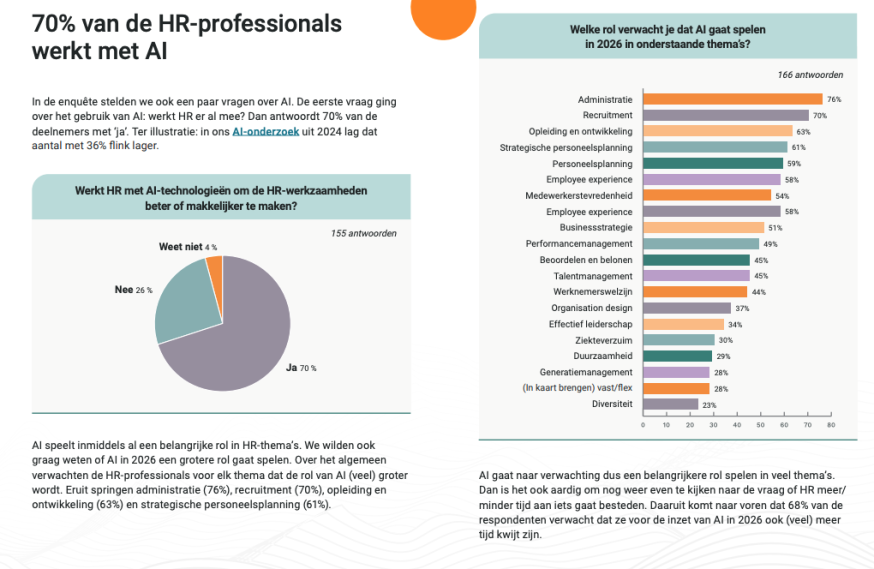
Figure 1 - 70% of HR professionals are already working with AI; the largest role is expected in administration, recruitment, and learning & development (Brightmine, Themes for HR in 2026)
Data card - AI in HR in 8 figures
70% of HR professionals are already using AI technology to make HR work easier:
 
- 50% believe that their own knowledge about the use of AI is currently (still) too low.
- 45% explicitly state that they need more AI knowledge to function well at all.
- 40% spend (very) little time on AI and 8% spend no time at all.
- 76% expect that AI will play a significant role in HR administration by 2026.
- 70% see an important role for AI in recruitment; 63% expect a larger role in training and development.
- 68% think that HR will spend (much) more time on the use of AI in 2026 than now.
- Only 27% have goals or KPIs for the use of AI; nearly three-quarters are not yet managing this.
Tip for the reader: compare your own HR team with these eight figures. Do you recognize the high adoption, but also the knowledge and KPI gap?
Where does HR stand now with AI?
Looking at the figures, AI in HR seems to be "business as usual". Seven out of ten respondents say they use AI technology to make HR work better or easier. In a similar study from 2024, that share was still around 36%; in another Brightmine study from late 2024, 46% indicated they were already working with AI. Adoption has nearly doubled in a short time.
In practice, it often concerns applications that are closely related to existing work:
 
- generating or rewriting texts (job descriptions, letters, emails to candidates or employees);
- summarizing long documents, files, or management meeting minutes;
- creating first drafts for policy notes, job profiles, or training programs;
- internal "HR assistants" that answer standard questions from employees about leave, regulations, or employment conditions.
A broader view of what AI means in the workplace - also outside HR - can be found in AI in the workplace: are you already prepared?.
These are useful applications, especially in organizations where HR spends a lot of time on administration and communication. The Brightmine research shows that HR claims to spend (very) much time on recruitment (55%), administration (51%), and absenteeism (48%). It is precisely in these areas that AI can help alleviate repetitive work.
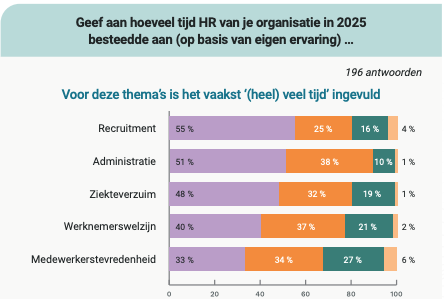
Figure 2 - HR spends especially (very) much time on recruitment, administration, and absenteeism - precisely the areas where AI can relieve the most according to HR.
At the same time, the picture is far from reassuring. Half of HR professionals indicate that their knowledge of AI is (still) not up to par. And in the benchmark, we see that 45% specifically say for "use of AI": to function adequately, we need more knowledge in this area.  
Moreover, 40% spend (very) little time on AI and 8% spend no time at all. In many organizations, this creates a tension: AI is already being used, but there is too little time and knowledge to embed it consciously, understand risks, or truly redesign processes. The result is that AI often still feels like a handy tool "on the side", not as a strategic colleague. 
Where does HR see the biggest opportunities?
Despite the knowledge gap, HR is remarkably united about the potential of AI. Almost all themes in the research score high on the question of whether AI will play a larger role in 2026. Four domains stand out: administration, recruitment, learning & development, and strategic workforce planning.  
1. AI in HR administration (76%)
Administration is traditionally the domain where HR feels it is "lagging behind the facts". Contracts, letters, changes, email exchanges, and file creation require a lot of time and precision. It is therefore not surprising that 76% expect AI to play a significant role here by 2026. 
Specifically, this involves:
 
- generating standard letters and contract appendices based on templates and HR data; 
- creating summaries of extensive personnel files or case studies; 
- automatically translating policy documents into understandable language for employees; 
- having HR reports and dashboards prepared by an AI assistant. 
If set up correctly, AI can free up a lot of time in the administrative layer. That time can then be used for conversations with employees, strategic workforce planning, or guiding managers. 
2. AI in recruitment (70%)
Recruitment is a structurally painful issue for many organizations: 55% of respondents cite it as a theme where they spend (very) much time, and it consistently ranks in the top two of "painful issues". 
AI fits precisely with that time and pressure factor. Consider applications such as:
 
- writing, rewriting, and tailoring job descriptions to different target groups; 
- pre-selecting resumes and cover letters based on pre-set criteria; 
- generating interview questions or assessments per job profile; 
- chatbots that answer candidates' questions, schedule appointments, or provide updates on the status of an application. 
Here lies an important nuance: AI can indeed help with the preliminary processing of information and communication, but HR remains responsible for the final selection, the conversation, and the choice. In other words: AI can make the funnel more efficient, but it must not be the sole voice in who gets in or not. 
3. AI in learning & development (63%)
63% of the surveyed HR professionals expect that AI will play a larger role in training and development by 2026. This is logical: organizations struggle with skill gaps, digitization, and an increasingly diverse population. 
AI makes it possible to:
 
- personalize learning paths based on function, ambitions, and existing skills; 
- generate microlearning (short modules, quizzes, summaries) around current themes; 
- analyze training data and make skill gaps visible to managers;
- allow employees to receive suggestions for relevant training or internal moves. 
For HR, this offers an opportunity to organize learning & development less ad-hoc and more data-driven - provided you set clear goals and keep the dialogue with employees central. 
4. Strategic themes: workforce planning, employee experience, and strategy
It is striking that AI is not only seen as a tool in operations. 61% expect a larger role in strategic workforce planning, 58% in employee experience, and 54% in business strategy.  
This shifts AI slowly from "handy text generator" to an analytical tool that helps calculate scenarios, reveals trends in turnover, absenteeism, and skills, and better substantiates HR decisions. A concrete example of such a data-driven approach can be found in How you can predict your work performance with AI in 2025.
This requires not only technical knowledge but also comfort in working with data, scenarios, and uncertainty. How this movement fits within broader HR trends for the coming years can be read in HR through the crystal ball: 5 trends for 2025.
The blind spot: knowledge, KPIs, and governance
That AI has a lot of potential is clear. The question is mainly: how do you ensure it doesn't remain a toy? The Brightmine research reveals the same weak spot three times: knowledge, KPIs, and governance. 
Knowledge gap around AI
For classic HR themes such as absenteeism, administration, and training, a large majority believes there is enough knowledge to function at least "adequately". For AI, it is different: 45% indicate that more knowledge is needed to function well, and it is one of the themes with the largest knowledge deficit, alongside generational management and organization design. How large that gap is in practice is shown in the article Mandatory knowledge about AI is lacking among seven out of ten HR professionals.
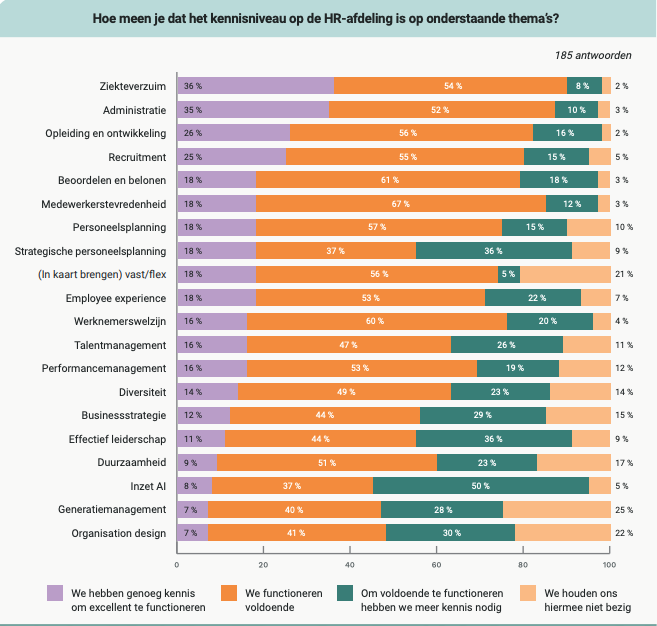
Figure 3 - For most HR themes, people find the knowledge (more than) sufficient, but regarding the use of AI, about half explicitly state they need more knowledge.
You can see this reflected in practice:
 
- HR teams that mainly rely on a few "tech-savvy" colleagues; 
- use of open AI tools without clear agreements about data and privacy; 
- reluctance to use AI for more complex issues, out of fear of mistakes or bias. 
No goals, no steering information
Also on the KPI side, there is often a lack of guidance. For absenteeism, employee satisfaction, and recruitment, a majority works with objectives and KPIs. For AI, it is exactly the opposite: 73% have no goals or KPIs for the use of AI, only 27% do.
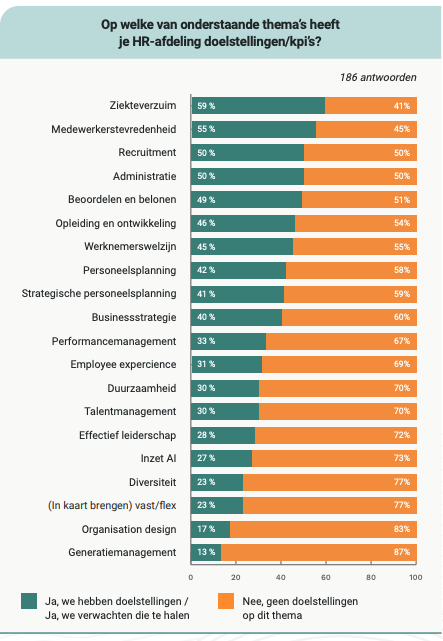
Figure 4 - For absenteeism, employee satisfaction, and recruitment, KPIs are standard; for the use of AI, only 27% of HR departments have concrete goals.
This means that many organizations are doing "something with AI", but do not have clarity on:
 
- what it should deliver;
- how to measure whether processes are becoming faster, better, or fairer;
- when a pilot is successful and can be scaled up.
Without clear goals, AI remains stuck in isolated experiments and trial balloons. 
Risks: bias, privacy, and quality of decisions
Once you use AI for recruitment, evaluation, or promotion decisions, ethics and legislation come into play. Think of:
 
- bias in training data, causing certain groups to systematically have less chance; 
- use of personnel data in tools where it is unclear where the data is stored; 
- "automation bias": people adopt AI suggestions because they assume the tool knows better. 
Without governance - rules, responsibilities, and controls - you increase risks instead of enhancing resilience. 
Human factor
An interesting insight from the open answers in the Brightmine research: HR professionals emphasize that AI actually requires more human contact and communication. They mention, among other things: "more conversation with people instead of wanting to automate everything" and "AI adds value, but this requires retraining and new competencies".  
In short: AI in HR is not a quick fix, but a transformation in knowledge, processes, and role perception. 
From experiment to practice: 5 concrete steps for HR
How do you translate this into daily practice? The following steps help to implement AI step by step without losing sight of the human element. 
1. Start with a clear process, not with a tool
AI tools are tempting: you can do "something smart" with just a few clicks. But sustainable effect only arises when you start with a concrete process.
 
- Choose one process where there is currently a lot of time or frustration - for example, standard letters, job descriptions, or summarizing absenteeism files. 
- Describe how the process currently runs, where the waiting times are, and what errors often occur. 
- Predefine what success looks like: 30% less turnaround time, fewer correction rounds, higher satisfaction among candidates or managers. 
Only then will you look at which AI tool fits best and how to embed it in your existing systems and workflows. 
2. Establish AI governance (together with IT and legal)
Governance sounds heavy, but it prevents hassle later. Outline the main points:
 
- which AI tools are allowed (and which are explicitly not); 
- which data may and may not be entered into AI systems; 
- who is ultimately responsible for the outcome of AI-supported processes (spoiler: that remains HR/managers); 
- how to handle privacy, retention periods, and employees' rights to access. 
Align this with existing policies regarding information security and GDPR. In GDPR: what does that mean in labor law for your company? you can read what GDPR concretely means in employment relationships. This way, you prevent everyone from using their own AI solutions "secretly" out of sight of IT and the privacy officer. 
3. Invest specifically in AI skills for HR
If half indicate they have insufficient knowledge, it is clear: a one-time AI workshop is not enough. Build a learning path for your HR team:
 
- Basic level for everyone: writing good prompts, critically assessing output, recognizing risks, and knowing when not to rely on AI. 
- Deepening for key functions such as recruitment, L&D, and HR analytics: working with datasets, bias checks, effect measurement, scenarios. 
- Ongoing development: schedule a short update session every quarter to discuss new use cases, legal developments, and best practices. 
Structural upskilling makes the difference between "having looked at ChatGPT once" and being able to truly deploy AI as a colleague. 
4. Make AI measurable with existing HR KPIs
You don't need to invent a separate "AI scorecard", but you do need to see what the implementation yields. Link AI experiments to existing HR KPIs, for example:
 
- Administration: turnaround time of contracts, number of correction rounds, error margin in letters. 
- Recruitment: time-to-hire, candidate experience, diversity of shortlists. 
- Learning & development: participation in modules, completion rates, satisfaction with development opportunities. 
- Document which KPIs you follow for each pilot and compare before and after. This way, you can make informed decisions about scaling up, adjusting, or stopping. 
5. Keep the human element central
Finally, the most important step: use AI to free up more time for human work, not less.
 
- Make it explicit in policy and communication that AI is a tool; decisions about people remain with people. 
- Involve the works council and employees in the implementation: what do they find acceptable, where do they see opportunities or concerns? 
- Discuss with managers how AI changes their role: more focus on conversation, feedback, and coaching; less on administration. 
Approaching AI this way not only increases HR productivity but also strengthens trust in the organization. 
Conclusion AI in HR
AI has quietly become a fixed factor in daily HR work. Most HR professionals are already using one or more AI tools, especially around administration and recruitment. At the same time, the Brightmine research shows that knowledge, KPIs, and governance are still lagging behind. Half feel inadequately equipped, three-quarters do not manage the use of AI with clear goals, and yet 68% expect that AI will require much more time in 2026 than now.  
The strategic choice for HR is therefore clear: do not wait until AI is "ready", but start now with conscious design. By starting with concrete processes, agreeing on clear rules, investing in AI skills, and linking results to existing KPIs, AI can grow from a loose tool to a full-fledged colleague. Not to replace the human side of HR, but to create more space for it. 
Those who set this up now will not only be administratively stronger in a few years but also strategically: as a conversation partner for management and employees in a labor market where technology, talent, and trust are inextricably linked.
Those who want to look beyond just AI in HR can read this article: AI for companies: how to create real value
Methodology
This article is based in part on the Brightmine research Themes for HR in 2026. A total of 463 HR professionals participated in this benchmark. Most participants (64%) work in organizations with 11 to 249 employees; 70% serve as HR advisor or HR manager.