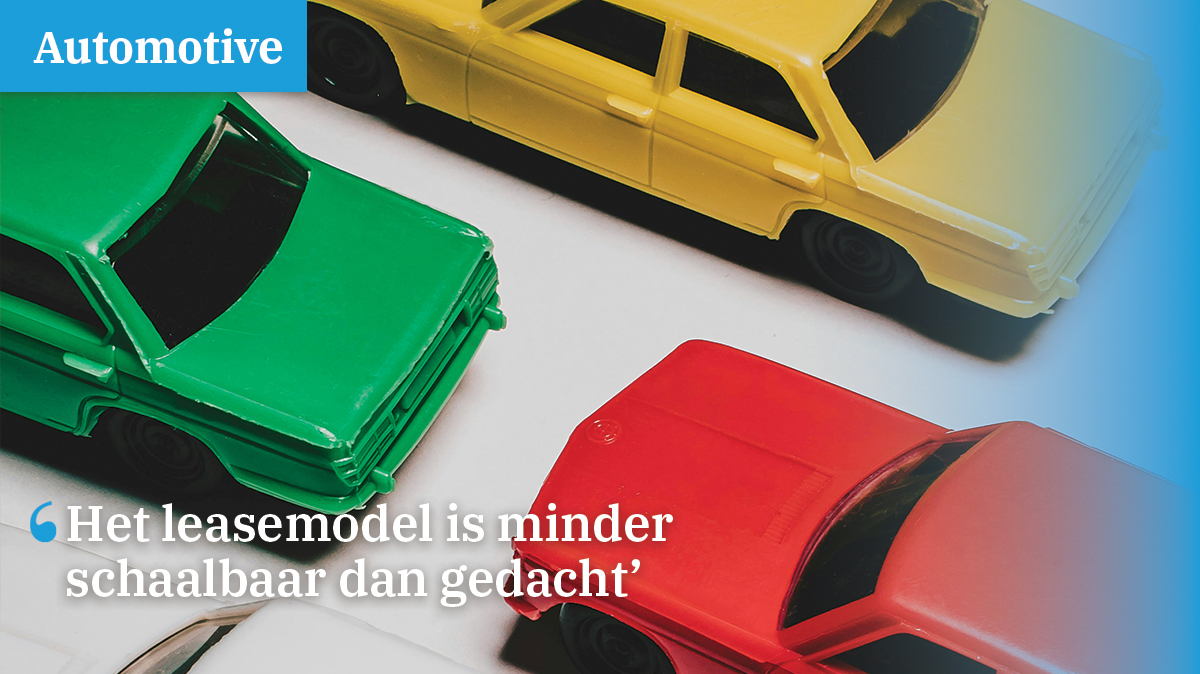

The classic leasing model under pressure
Car leasing has been the way for companies to arrange mobility without directly investing in a fleet for decades. Monthly costs were clear, maintenance was outsourced, and cars could be replaced periodically. But that model also has its limitations. And those limitations are becoming increasingly visible in the current economy.
Lease terms between parking spaces and the office, limited flexibility, high penalties for early termination, and limited freedom of choice in switching vehicles are often present. Additionally, themes such as sustainability, digitalization, and mobility-as-a-service bring new expectations. Fixed contracts no longer always fit flexible work forms, growing teams, or hybrid work environments.
The question that is being asked more frequently is: should a company still 'fixed' lease, or are there more modern, better-fitting alternatives to car leasing available?
Perception is changing
More and more companies are reconsidering their mobility strategy. Where it was once taken for granted to assign a fixed lease car to each employee for several years, that is not always efficient today. Various studies show that many vehicles are stationary for a large part of the time. At the same time, the number of kilometers per car is decreasing due to remote work, shared use, or multimodal mobility (car + public transport + bicycle).
The younger generation of employees also views car ownership differently. Freedom, flexibility, and sustainability weigh more heavily than the prestige of a lease car. Instead of thinking in terms of ownership or contracts, they think in terms of access: I want to get somewhere, not necessarily own something.
Furthermore, there is criticism of the real costs of leasing. In addition to the fixed monthly amount, there are costs for excess kilometers, fuel, damage repair, fines, and additional tax. Entrepreneurs thus face less predictable costs than initially thought. The leasing model is often less scalable than expected, and especially for smaller companies or freelancers, this can be a limiting factor.
What alternatives to car leasing are there?
The mobility market has not stood still in recent years. Innovative providers are responding to the need for more flexibility, scalability, and cost transparency. The most common alternatives to car leasing are:
1. Car sharing
Through platforms like Greenwheels or SnappCar, it is possible to use cars without owning or leasing them. You pay per hour or per day and book via an app. Some platforms focus on individuals, while others also have business accounts for companies that share cars within teams or regions.
This is also possible by encouraging carpooling among colleagues. This way, a service does not necessarily come into play, but you can offer a budget for employees who make their own car available.
 
- Advantage: very flexible, no fixed costs, sustainable due to higher utilization.
- Disadvantage: dependent on availability, not always suitable for daily use.
- Suitable for: companies in urban areas, project-based work, freelancers.
2. Car subscriptions
Car brands, leasing companies, and startups are increasingly offering 'car bundles': a monthly subscription in which you get a car of your choice including insurance, maintenance, and the option to regularly switch models. Well-known examples are Lynk & Co and MyWheels Business.
 
- Advantage: maximum flexibility, all costs in one rate, often cancellable monthly.
- Disadvantage: higher monthly costs than traditional leasing, sometimes limited availability.
- Suitable for: hybrid working teams, startups, freelancers with varying mobility needs.
3. Digital used leasing (e.g., Lizy)
A relatively new model is leasing young used cars through digital platforms. The Belgian Lizy (also active in the Netherlands) specializes in this. You choose online from a range of second-hand lease cars, with lower monthly costs and shorter terms.
 
- Advantage: cheaper than new, quickly available, circularly responsible.
- Disadvantage: less choice, often no option to switch models during the term.
- Suitable for: budget-conscious companies, starting entrepreneurs.
4. Mobility budget instead of a car
More and more companies are moving away from the idea that every employee needs a fixed lease car. Instead, employees receive a mobility budget, allowing them to choose their own transportation: car, public transport, (shared)bicycle, taxi, or even remote work.
You can further strengthen this by offering NS business cards or bicycle services like PoldAr, from the previous magazine.
 
- Advantage: sustainable, flexible, encourages conscious mobility choices.
- Disadvantage: requires good administration and clear agreements.
- Suitable for: knowledge companies, consultancy, hybrid work forms.
Practical examples
In recent years, more and more large companies are switching to a different mobility mix. For example, ABN AMRO reduced a large part of its lease fleet and switched to a general mobility budget, FrieslandCampina introduced electric shared cars that employees could request via an app, and Arcadis switched to a mobility card with free choice between public transport, electric shared cars, and bicycles. The effect according to the companies:
 
- Lower CO₂ emissions
- Better utilization of vehicles, resulting in fewer stationary cars in parking spaces.
- Higher employee satisfaction
- Cost reduction
- 40% fewer car kilometers according to Arcadis itself
This is just a glimpse of companies that have rethought their mobility, but it already gives a striking picture of the benefits.
Why this is the moment to reconsider
Various trends make this the moment to look at alternatives to car leasing:
 
- Hybrid working reduces the number of commuting days per week.
- Sustainability pressure calls for less waste and better utilization of mobility.
- Technological acceleration means that cars age faster, requiring flexibility.
- Legal changes (such as CO₂ reporting obligation in 2025) encourage companies to handle mobility more consciously.
- Financial uncertainty calls for flexibility in fixed costs.
So take a look at your mobility system now; in times of rapid change, you as an entrepreneur must keep up with the changes. This starts with good preparation for change, which can then lead to cost savings.
Mobility that moves with you
The traditional car leasing is not passé, but it is less self-evident than ever. For those who value flexibility, sustainability, cost control, and freedom of choice, there are numerous alternatives to car leasing available: from car sharing to subscriptions and mobility budgets.
Entrepreneurs do well to scrutinize their current mobility model. Which cars are more often stationary than they are driving? Which employees really need a fixed car? Where can mobility be smarter, more flexible, or cheaper?
By choosing the right mobility mix, you not only save costs. You move with the times.